If you do the same workout with the same weights for months, your body stops changing. It has already adapted. Progressive overload is the simple principle that keeps strength and muscle improving: you gradually ask your body to do a little more than it is used to.
This guide explains what progressive overload is, the different ways to apply it, and how trainers can use it safely with clients of every level.
What Is Progressive Overload?
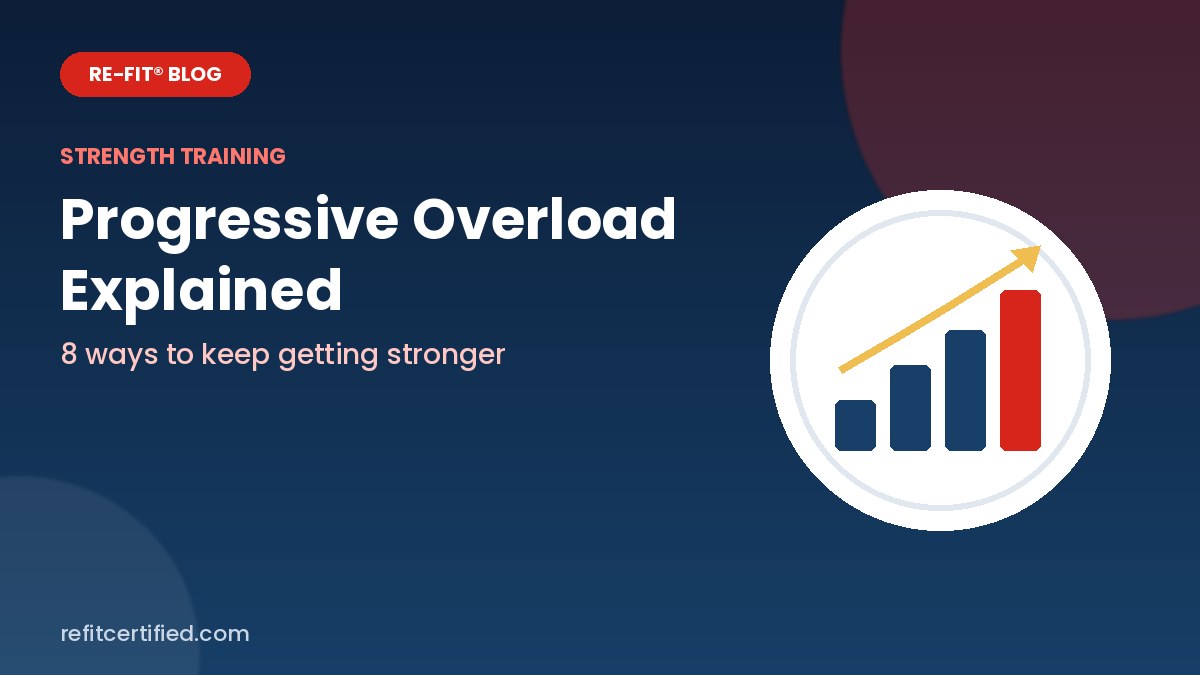
Progressive overload means increasing the training challenge over time. When muscles, tendons and the nervous system face a demand slightly above their current level, they adapt and become stronger. Once they adapt, the demand must rise again for progress to continue.
The key word is gradual. Big jumps in weight or volume increase the risk of injury and burnout. Small, regular steps add up to large results over months.
8 Ways to Apply Progressive Overload
1. Add weight
The most common method. When a client can complete all sets and reps with good form, increase the load slightly, for example by the smallest plates available.
2. Add repetitions
Keep the same weight and do more reps. A common approach is a rep range, such as 8–12: once all sets reach 12 with good form, increase the weight and start again at 8.
3. Add sets
Increasing the number of hard sets per muscle group each week raises total training volume.
4. Train more often
Training a muscle twice a week instead of once is another way to increase weekly volume, as long as recovery allows it.
5. Improve technique and range of motion
Going deeper in a squat with control, or pausing at the bottom of a press, makes the same weight more challenging.
6. Control the tempo
Slowing the lowering phase increases time under tension. This is useful when heavier weights are not available, such as in home workouts.
7. Reduce rest time
Shorter rest between sets increases density and conditioning. Use this carefully for heavy strength work, which usually needs longer rest.
8. Progress the exercise
Move from an easier variation to a harder one: knee push-ups to full push-ups, goblet squats to barbell squats, assisted pull-ups to bodyweight pull-ups.
A Simple Progression Example
Here is how a beginner might progress a goblet squat over several weeks:
- Week 1: 3 sets of 8 reps with a light dumbbell, focusing on form
- Week 2: 3 sets of 10 reps with the same dumbbell
- Week 3: 3 sets of 12 reps with the same dumbbell
- Week 4: heavier dumbbell, back to 3 sets of 8 reps
The pattern repeats. Progress is steady, measurable and easy for the client to understand.
Track Your Training
You cannot progress what you do not record. Write down exercises, weights, sets, reps and how hard each set felt. A notebook or app is enough. Tracking shows when it is time to progress and when it is time to hold.
When Progress Stalls
Every lifter hits plateaus. Before adding more training, check the basics:
- Sleep: poor sleep slows recovery and strength gains
- Nutrition: enough total food and protein to support training
- Recovery: a lighter "deload" week every few weeks can help
- Programme variety: changing rep ranges or exercise variations can restart progress
Safety Tips for Trainers
- Progress only when technique is consistent on every rep
- Change one variable at a time, not weight, sets and tempo together
- Expect slower progress with older clients, beginners returning after a break and people with past injuries
- Pain is a signal to stop and reassess, not to push through
- Refer clients with medical conditions for clearance before increasing intensity
Frequently Asked Questions
How often should I increase the weight?
Beginners can often progress every week or two. Experienced lifters progress more slowly, sometimes over several weeks. Let your training log guide you.
Does progressive overload work without a gym?
Yes. At home you can add reps, sets, slower tempo, shorter rest and harder bodyweight variations.
Is progressive overload only for muscle building?
No. It applies to strength, endurance, speed and even mobility. Any quality you want to improve needs a gradually increasing challenge.
Learn to Program Like a Professional
Writing safe, effective progressions is a core skill for every trainer. The RE-FIT Certified Personal Trainer course teaches programme design, exercise technique and client assessment, fully online and self-paced.
Written by Master Trainer Manoj, founder of RE-FIT Sports & Fitness Academy, which has been training fitness professionals since 2011.
Recommended Resources
Continue learning with relevant RE-FIT courses, programs, and publications.