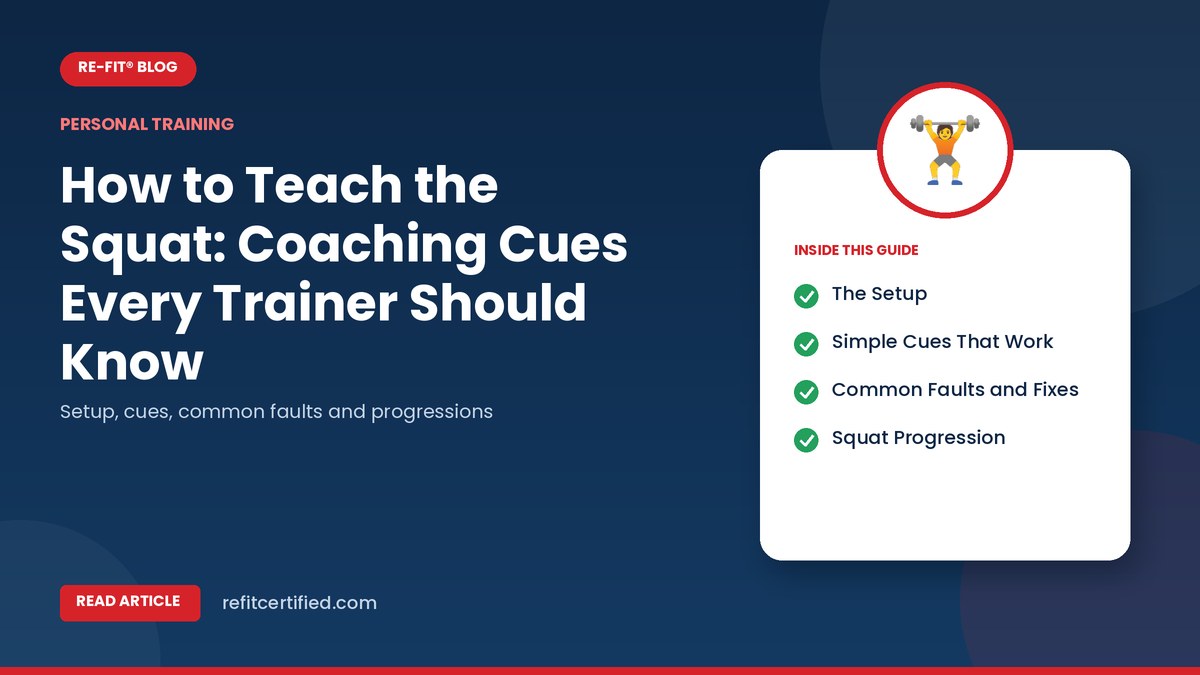
The squat is one of the most useful movements for daily life and sport. We squat when we sit down, pick something up or get out of a car. As a trainer, teaching a safe, confident squat is a core skill.
Step 1: The Setup
- Feet about shoulder-width apart, toes turned out slightly
- Weight spread across the whole foot
- Chest proud, eyes looking forward
- Take a breath and brace the core gently
Step 2: Simple Cues That Work
Use one or two cues at a time:
- "Sit down between your heels."
- "Knees follow your toes."
- "Keep your whole foot on the floor."
- "Stand up by pushing the floor away."
External cues (about the floor or an object) often work better than internal ones (about muscles).
Common Faults and Fixes
Knees caving inward
Cue "push your knees out over your toes", or place a light band above the knees as a reminder.
Heels lifting
Check ankle mobility, use a slightly wider stance, or temporarily place small plates under the heels while mobility improves.
Chest falling forward
Use a goblet squat; holding the weight in front helps keep the torso upright.
Not enough depth
Squat to a box at a comfortable height and lower the box gradually. Depth should be pain-free and controlled.
Lower back rounding at the bottom
Stop just above the point where the back rounds and work on hip and ankle mobility.
Squat Progression
- Bodyweight box squat
- Bodyweight squat
- Goblet squat with a dumbbell or kettlebell
- Front squat or barbell back squat with light weight
- Gradual load increases with consistent technique
Teaching Tips for Trainers
- Demonstrate first, then let the client try
- Watch from the front and the side
- Film a set on the phone so clients can see their own form
- Praise what they do well before correcting
A Simple 3-Step Teaching Sequence
- Show: demonstrate one good rep from the side so the client sees the hip and knee movement.
- Try: let the client perform three to five reps without corrections first.
- Refine: give one cue, let them practise, then add another cue if needed.
This keeps the client confident and avoids information overload.
Squat Variations for Different Goals
- Box squat: great for beginners and controlling depth
- Goblet squat: teaches an upright torso and good balance
- Front squat: strong quadriceps and upper-back demand
- Back squat: allows heavier loads for strength development
- Split squat: builds single-leg strength and balance
Warm-Up Before Squatting
Include hip circles, bodyweight squats, glute bridges and ankle mobility drills. Then do one or two light sets before working weight. A good warm-up often improves squat depth immediately.
Frequently Asked Questions
Are deep squats bad for the knees?
For healthy people, controlled squats through a comfortable range are generally safe. Clients with knee problems should get medical advice and train within pain-free ranges.
How often should beginners squat?
Two to three times per week, as part of a full-body plan, works well.
Coach Better With RE-FIT
Technique coaching is at the heart of personal training. Explore RE-FIT personal trainer certification.
Recommended Resources
Continue learning with relevant RE-FIT courses, programs, and publications.