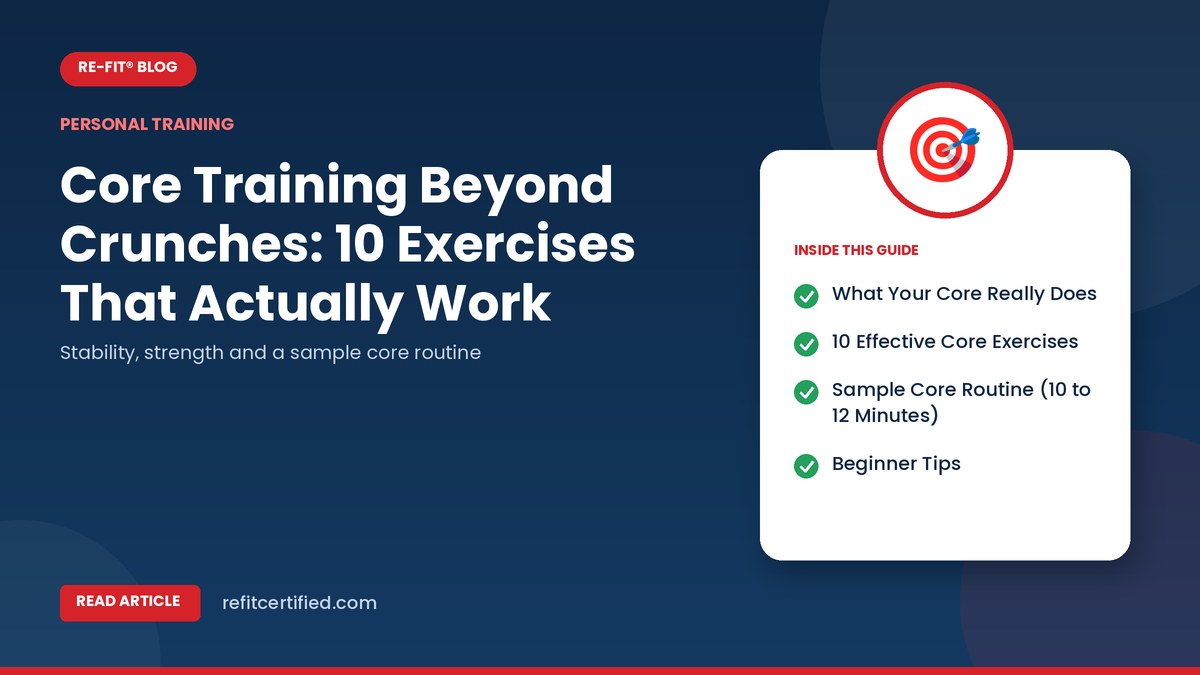
Many people think core training means hundreds of crunches. But your core is much more than the "six-pack" muscle. It includes the deep abdominal muscles, obliques, lower back and hip muscles that keep your spine stable when you lift, run, carry or twist.
What Your Core Really Does
- Resists movement: keeps the spine steady under load
- Transfers force: links the upper and lower body in lifting and sport
- Protects the back: supports good posture in daily life
So the best core exercises often train you to resist unwanted movement, not just to bend forward.
10 Effective Core Exercises
- Front plank: forearms and toes, body straight, squeeze glutes. Start with 20 to 30 seconds.
- Side plank: trains the obliques and hip stabilisers. Knees down for beginners.
- Dead bug: lying on your back, lower opposite arm and leg slowly while keeping the lower back flat.
- Bird dog: on hands and knees, extend opposite arm and leg without rotating the hips.
- Glute bridge: strengthens hips that support the lower back.
- Pallof press: with a band or cable at chest height, press forward and resist rotation.
- Farmer's carry: walk tall holding heavy dumbbells. Simple and very effective.
- Suitcase carry: carry a weight in one hand only; your core works to stay upright.
- Hollow body hold: a more advanced exercise; keep the lower back pressed to the floor.
- Bear crawl: on hands and toes with knees just off the floor, move slowly forward and back.
Sample Core Routine (10 to 12 Minutes)
Do 2 to 3 rounds, two or three times a week:
- Dead bug: 8 per side
- Side plank: 20 seconds per side
- Pallof press: 10 per side
- Farmer's carry: 30 metres
Beginner Tips
- Quality beats quantity: slow, controlled reps
- Breathe normally; do not hold your breath
- Stop if you feel pain in the lower back and regress the exercise
- Progress by adding time, load or harder variations
Do You Still Need Crunches?
Crunches are not "bad", but they train only one function of the core. A balanced plan includes anti-extension (plank), anti-rotation (Pallof press), anti-side-bending (side plank, suitcase carry) and hip strength (bridge).
How Core Training Helps Daily Life
A strong, stable core makes everyday tasks easier: lifting a child, carrying shopping bags, sitting at a desk for long hours or climbing stairs. Athletes benefit too, because a stable trunk helps transfer power when sprinting, throwing or jumping.
Progressing Your Core Exercises
- Plank: knees → toes → toes with shoulder taps → plank with reach
- Side plank: knees → feet → feet with top-leg lift
- Dead bug: arms only → legs only → opposite arm and leg → holding a light weight
- Carries: lighter weights for longer distance → heavier weights for shorter distance
Move to the next level only when you can complete the current one with good form for the planned time or reps.
Common Mistakes
- Letting the hips sag in a plank
- Arching the lower back during dead bugs
- Rushing reps instead of controlling them
- Training the core only at the end of a session when you are exhausted
Frequently Asked Questions
Will core exercises reduce belly fat?
No exercise burns fat from one area only. Fat loss comes from overall training, nutrition and lifestyle. Core training builds strength and stability.
How often should I train my core?
Two to four short sessions per week is enough for most people.
Learn Smarter Training With RE-FIT
Understanding movement helps trainers coach better core training. Explore RE-FIT personal trainer certification.
Recommended Resources
Continue learning with relevant RE-FIT courses, programs, and publications.