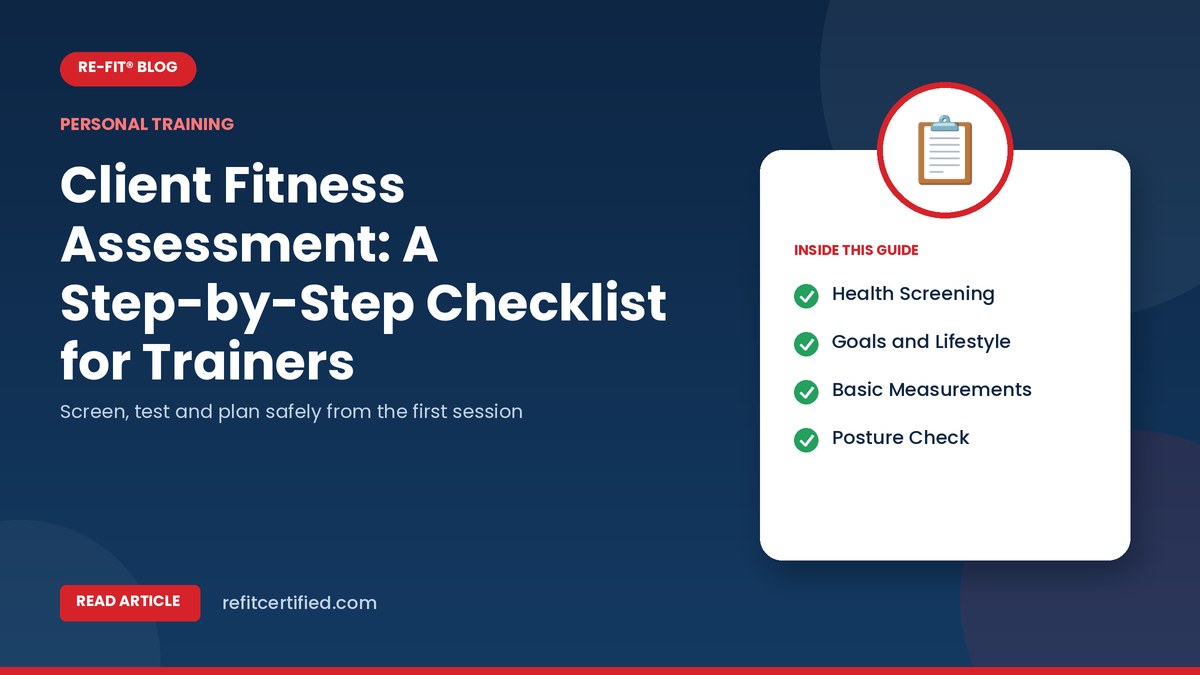
A good training program starts with a good assessment. Without it, you are guessing. With it, you know where your client starts, what to avoid and how to measure progress.
This checklist gives personal trainers a simple, safe structure for the first session with a new client. You can complete it in 45 to 60 minutes.
Step 1: Health Screening
Safety comes first. Before any exercise, ask about:
- Known medical conditions (heart, blood pressure, diabetes, asthma)
- Past injuries and surgeries
- Current pain, dizziness or chest discomfort during activity
- Medicines the client takes regularly
- Pregnancy or recent childbirth
Many trainers use a standard pre-activity questionnaire such as the PAR-Q+. If any answer raises a concern, ask the client to get clearance from a doctor before starting training. Never diagnose; refer.
Step 2: Goals and Lifestyle
Understand the person, not just the body. Ask:
- What do you want to achieve in 3 months? In 12 months?
- Why is this important to you now?
- How many days and minutes can you train each week?
- How are your sleep, stress and work hours?
- What have you tried before, and what stopped you?
Write the main goal in the client's own words. You will use it to keep them motivated.
Step 3: Basic Measurements
Take only the measurements the client is comfortable with. Common options:
- Body weight
- Waist circumference
- Resting heart rate
- Progress photos (only with consent, stored privately)
Remind clients that the scale is only one number. Strength, energy and how clothes fit matter just as much.
Step 4: Posture Check
Observe the client standing from the front and side. Look for:
- Head pushed forward
- Rounded shoulders
- One shoulder or hip higher than the other
- Excessive arch or flatness in the lower back
- Knees falling inward or feet turning out
Note what you see, but do not alarm the client. Small differences are normal.
Step 5: Movement Screening
Ask the client to perform a few simple movements while you watch quality, not quantity:
- Bodyweight squat: do the heels lift, knees cave in or the chest drop?
- Lunge or split squat: can they keep balance and control?
- Push-up or incline push-up: does the lower back sag?
- Hip hinge: can they bend from the hips with a flat back?
- Overhead reach: can arms go overhead without arching the back?
Step 6: Strength and Endurance Tests
Choose tests that match the client's level:
- Push-ups (full or incline) in good form
- Plank hold time
- Bodyweight squats in 60 seconds
- Wall sit time
Stop any test as soon as form breaks down. The goal is a safe baseline, not exhaustion.
Step 7: Cardio Fitness Check
For beginners, a simple walking test or step test is enough. Note heart rate before and after, and how quickly it comes down. For fitter clients you can use a timed run or cycle test.
Step 8: Turn Results Into a Plan
An assessment is only useful if it changes the program. After the session:
- List the top three priorities, such as "improve squat depth" or "build core endurance"
- Choose exercises that fit the client's current ability
- Set a re-test date, usually after 4 to 6 weeks
- Share a short written summary with the client
Printable Assessment Checklist
- Health questionnaire completed and signed
- Medical clearance obtained if needed
- Goals and lifestyle recorded
- Measurements taken with consent
- Posture observed and noted
- Movement screen completed
- Strength and endurance baseline recorded
- Cardio check completed
- Priorities and re-test date agreed
Frequently Asked Questions
How often should I reassess clients?
Every 4 to 8 weeks works well for most clients. Regular re-tests show progress and keep clients motivated.
Should I charge for the assessment?
Many trainers include it in a package. A short free assessment can also help new clients decide to start.
What if a client has a medical condition?
Ask for doctor clearance and follow any advice given. Work within your scope as a trainer and refer when needed.
Learn Assessment and Program Design With RE-FIT
Assessment, safety and program design are core skills for every personal trainer. Explore RE-FIT personal trainer certification to build them properly.
Recommended Resources
Continue learning with relevant RE-FIT courses, programs, and publications.