Beginners do not need complicated programs. They need a plan that is safe, simple and easy to stick to. As a trainer, your job is to build confidence first and results soon after.
Here is a clear process for designing a beginner program, plus a sample four-week plan you can adapt.
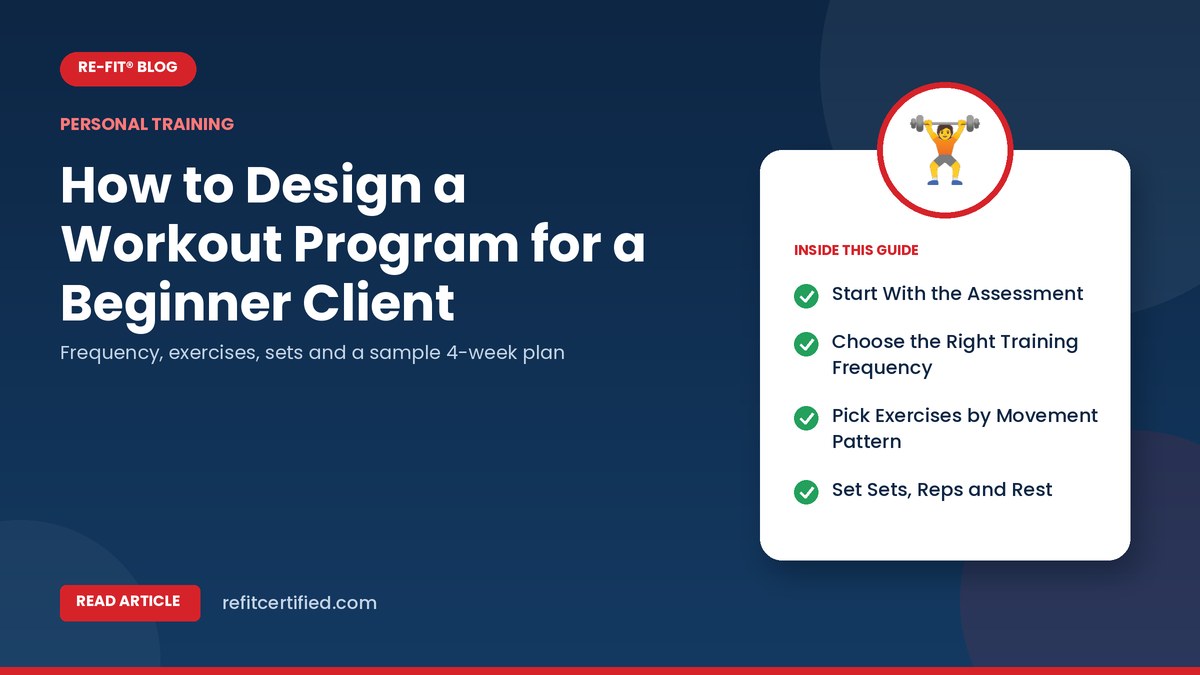
Start With the Assessment
Use the client's health screening, goals and movement check to decide what to include and what to avoid. A client with knee discomfort may start with box squats instead of deep squats. A client with poor core control may need more plank variations before heavy lifts.
Choose the Right Training Frequency
For most beginners, two to three full-body sessions per week work best. Full-body training:
- Trains each muscle group more than once a week
- Allows rest days between sessions
- Still works if the client misses a day
Pick Exercises by Movement Pattern
Build each session around basic human movements, not individual muscles:
- Squat: goblet squat, box squat
- Hinge: Romanian deadlift with dumbbells, hip bridge
- Push: incline push-up, dumbbell chest press
- Pull: seated cable row, lat pulldown, band row
- Carry or core: farmer's carry, plank, dead bug
One exercise from each pattern gives a balanced session in about 45 minutes.
Set Sets, Reps and Rest
- Sets: 2 to 3 per exercise
- Reps: 10 to 15 for most exercises
- Rest: 60 to 90 seconds
- Effort: finish each set with 2 to 3 reps "in the tank"
Higher reps with lighter loads let beginners practise technique safely.
Always Include Warm-Up and Cool-Down
Start with 5 to 10 minutes of light cardio and mobility, such as marching, arm circles, hip openers and bodyweight squats. End with easy walking and gentle stretches. This habit reduces injury risk and teaches clients good routines.
Plan Progression
Beginners improve quickly, so the program must change. Progress one thing at a time:
- Add 1 to 2 reps per set
- Add a set
- Increase the weight slightly once all reps feel controlled
- Move to a harder exercise version, for example incline push-up to floor push-up
Sample 4-Week Beginner Plan
Weeks 1 and 2 (3 days per week)
- Goblet squat to box: 2 x 12
- Hip bridge: 2 x 15
- Incline push-up: 2 x 10
- Seated cable row: 2 x 12
- Plank: 2 x 20 seconds
Weeks 3 and 4 (3 days per week)
- Goblet squat: 3 x 12
- Dumbbell Romanian deadlift: 3 x 10
- Incline push-up (lower incline): 3 x 10
- Lat pulldown: 3 x 12
- Farmer's carry: 3 x 30 metres
- Dead bug: 2 x 8 per side
Track and Communicate
Record weights, reps and how each exercise felt. Share small wins with the client every week: "Last week you did 8 push-ups, today you did 10." Visible progress keeps beginners coming back.
Common Mistakes to Avoid
- Too many exercises in one session
- Training to failure in the first weeks
- Copying an advanced athlete's program
- Ignoring sleep, stress and recovery
- Changing exercises every session so the client never improves at anything
Frequently Asked Questions
How long should a beginner stay on one program?
Usually 4 to 6 weeks, adjusting load and reps along the way, then update the exercises based on progress.
Should beginners use machines or free weights?
Both are useful. Machines help with confidence, while simple free weight exercises teach balance and coordination.
Can beginners train every day?
Light activity like walking is great daily, but strength sessions need rest days for recovery.
Master Program Design With RE-FIT
Program design is one of the most valuable skills a trainer can have. Explore RE-FIT certifications to learn it with practical, step-by-step guidance.
Recommended Resources
Continue learning with relevant RE-FIT courses, programs, and publications.